
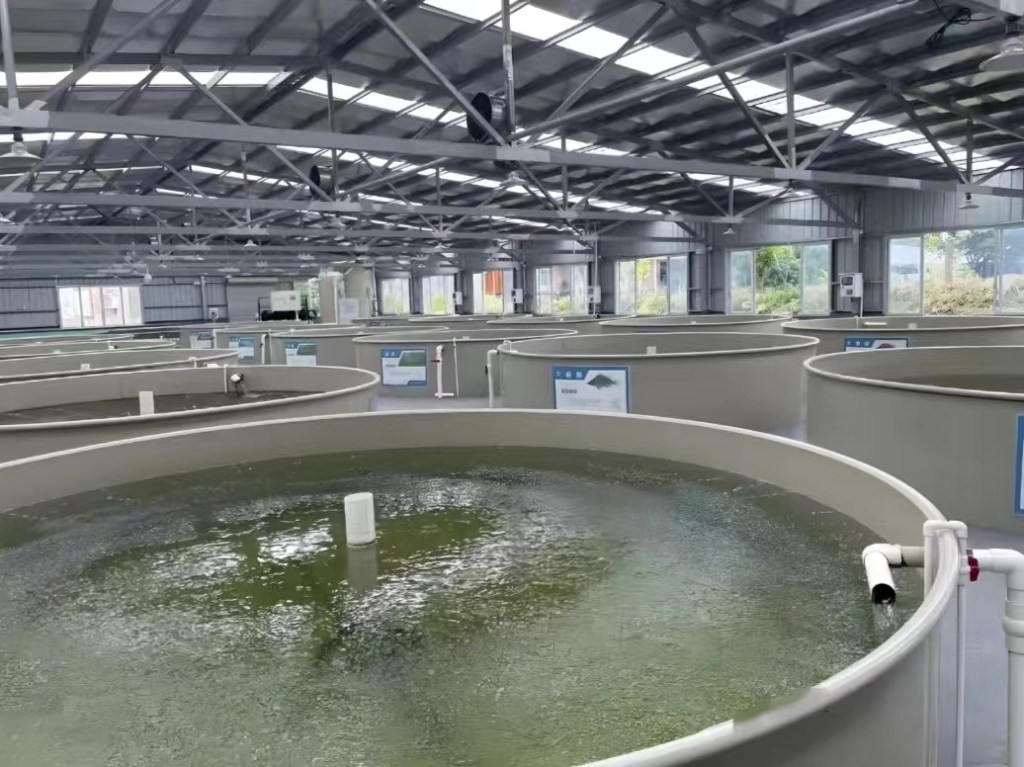
Aquaculture Tank Material Comparison: Galvanized Canvas vs PP vs FRP in RAS
An aquaculture tank material comparison covering pros, cons, service life, temperature limits and real cost for the three mainstream tank materials — practical notes from the production floor, so you can avoid most of the ways tanks fail.
At a Glance
Why Material Is the #1 Tank Decision
Last year a farm owner came to us with this: "I put close to $110,000 into a recirculating system last year. One heat wave later every liner had fused solid, I lost a batch of fingerlings, and now all the tanks have to be replaced. How is that not a total loss?"
We looked at the site — galvanized canvas tanks, standard PVC liners, and no shade structure anywhere. In a hot southern climate under full summer sun, a liner in that setup will not last 18 months.
That case is not unusual. Among the RAS customers we supply, close to half of all "tank problems" trace back to the material decision made at the very start. Pick the wrong structure and the downstream bill — replacement tanks, downtime, dead stock — dwarfs the few thousand dollars you saved up front. That is exactly what a proper aquaculture tank material comparison is meant to prevent.
So the point of this article is a straight aquaculture tank material comparison: the real pros and cons of galvanized canvas, PP and FRP tanks inside a RAS recirculating system, laid out plainly so anyone mid-selection has a clear frame of reference. Every photo below shows tank equipment we supplied to working farms — real installations under real operating conditions — so you have something concrete to compare against.
Head-to-Head Aquaculture Tank Material Comparison
Before the detail, here is the full picture of this aquaculture tank material comparison in one table. The figures come from our own production data, long-term customer follow-up and published industry references; processes differ between manufacturers, so treat it as a selection guide rather than a spec sheet. It is also the first table we open in any aquaculture tank material comparison.
| Criteria | Galvanized Canvas Tank | PP Tank | FRP Tank |
|---|---|---|---|
| Structure | Galvanized steel wall + PVC canvas liner | Bolted PP panels / welded one-piece | Glass-fibre reinforced plastic (SMC moulded or hand lay-up) |
| Service life | Liner 2–5 yrs / steel ring 8–15 yrs | 8–15 yrs | 15–30+ yrs |
| Temperature range | -10 °C to +40 °C (liner-limited) | -10 °C to +80 °C | -40 °C to +110 °C |
| Corrosion resistance | Fair (liner sensitive to acids, alkalis, seawater) | Good (acids, alkalis, salts) | Excellent (acids, alkalis, salts, oils) |
| Cost per m³ | Low | Medium | High |
| Common sizes | Ø 3–6 m, H 1–1.5 m | Ø 2–10 m, H 1–2 m | Ø 2–12 m, H 1–3 m (modular) |
| Installation effort | Very low (half a day) | Medium (on-site assembly) | Medium (modular) / low (one-piece) |
| Best suited to | Small trials, transition tanks, tight-budget start-up | Medium to large RAS, freshwater and seawater | Industrial RAS, marine culture, aggressive water |
| Main risk | Liner ages fast, punctures easily | Less rigid than FRP at large diameters | High upfront cost, heavier logistics |
This aquaculture tank material comparison table should give you the shape of it. In practice, choosing a fish tank material comes down to three variables: your water, your site and your time horizon. Now let's take each material apart.
Galvanized Canvas Tanks: Lowest Upfront Cost, Highest Exposure
The galvanized canvas tank is the cheapest and fastest way to get water in a circle. The logic is simple: a ring of galvanized corrugated steel holds the shape, and a PVC canvas liner (known in the trade as a knife-coated fabric or PVC liner) holds the water. In any aquaculture tank material comparison, this is the option that wins on entry cost and loses on service life.
What it does better than anything else
- Very low barrier to entry: factory-direct, a 4 m diameter unit can come in around a thousand dollars. That suits a first-time farmer testing the water on a limited budget.
- Ready the day it lands: prefabricated, and two people can have one standing in half an hour. No specialist crew required — nothing else in this comparison matches it.
- Dismantles and moves: take it down, relocate, rebuild. Invaluable on leased or rotational land.
Three traps that catch first-time buyers
- The liner cannot take the sun: under UV load a PVC liner starts to stiffen and go brittle in about two years. Outdoors you need shade netting or a roof, or you are replacing liners every season.
- Sharp objects end it: stone, wire, a fallen branch — any of them can puncture the liner. One leak in a RAS means shutting down the whole treatment loop.
- No hot water or steam disinfection: hot water or steam will deform or melt the liner, and long-term exposure to salt and chlorine in marine systems accelerates chalking and breakdown.

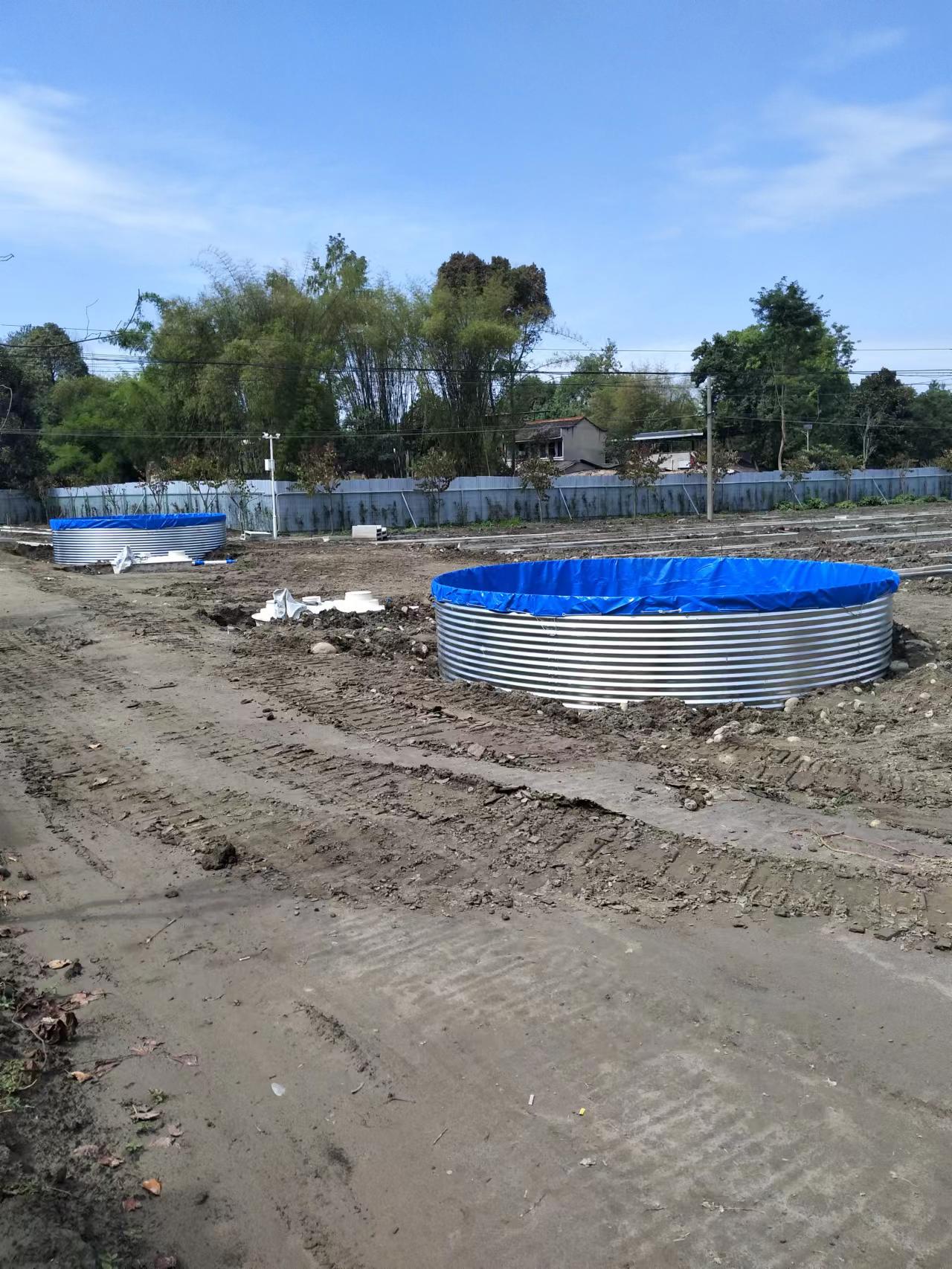
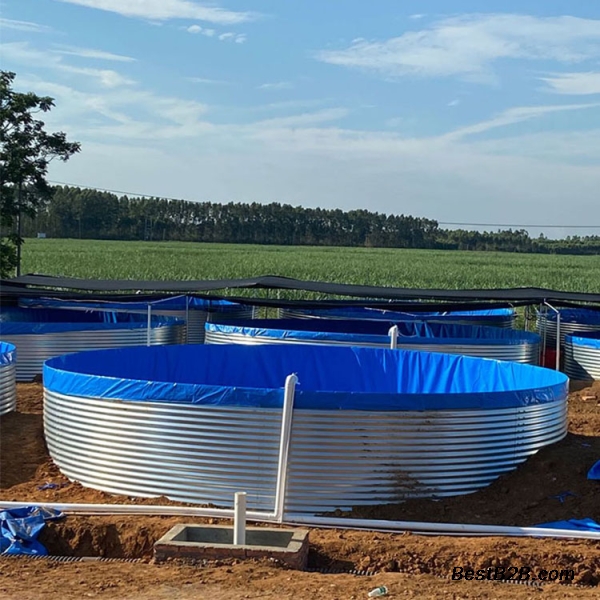
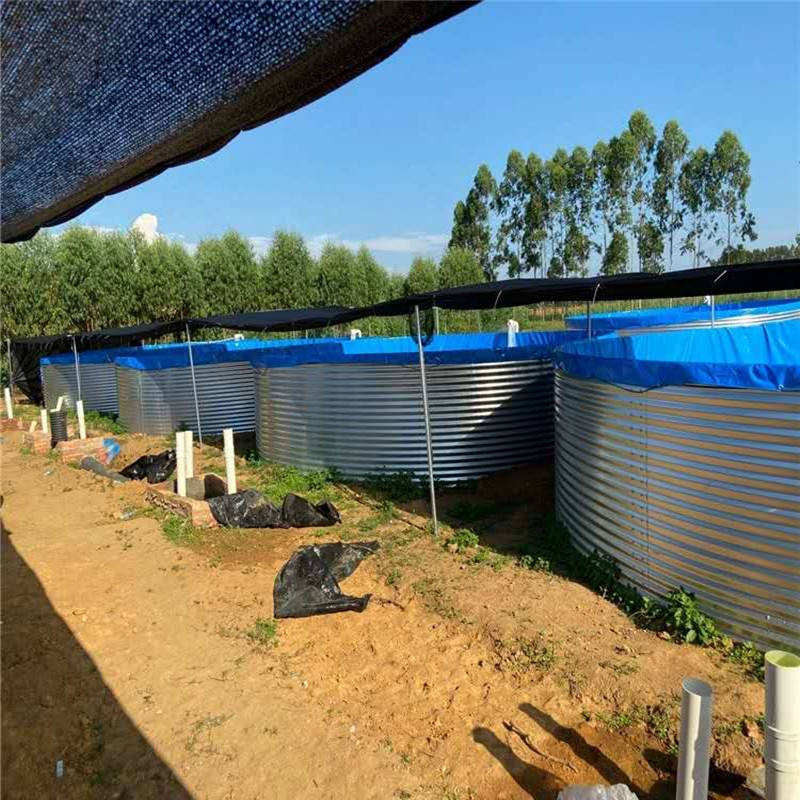
Right for: first-time farmers, low-budget trials, temporary projects, cool freshwater applications.
Wrong for: long-term industrial RAS, marine culture, high-sun tropical sites, or any open yard without shade. Treat it as a short-horizon answer when you run your own aquaculture tank material comparison, not as the final one.
PP Tanks: The Workhorse of Recirculating Systems
PP is polypropylene, a food-grade plastic — the same family as food containers and baby bottles. A standard PP fish tank is built from PP sheet bolted together with seals into a round or square vessel, and diameters from 2 m up to 10 m are all routine. Across a typical aquaculture tank material comparison, PP is the middle path: more durable than canvas, cheaper than FRP.
Why more RAS operations are standardising on PP
- Food-grade safety: PP is a food-contact material — odourless, non-toxic, and it does not leach plasticisers into the water. That matters enormously in hatchery and nursery work.
- Strong chemical resistance: it handles acids, alkalis and salt, so seawater, brackish water and sodium hypochlorite disinfection are all fine. The chemical stability of polypropylene is the core reason it is used so widely for culture vessels.
- Modular and movable: panels are prefabricated and bolted on site. If you relocate or scale up later, you dismantle and rebuild — the asset moves with you.
- Smooth, easy to clean: the inner wall is non-porous, so there is nowhere for biofilm to hide. Cleaning is far easier than with a liner tank.
Two things to watch with PP
- Rigidity falls off at large diameters: past roughly 6 m, water pressure makes the panels bow slightly, so you need an external steel band or internal bracing. Plenty of small workshops will not volunteer that.
- Long-term UV is still a factor: UV-stabilised PP ages well, but on high-altitude sites or exposed yards in strong sun, a roof is still advisable — otherwise the walls slowly chalk and go brittle.
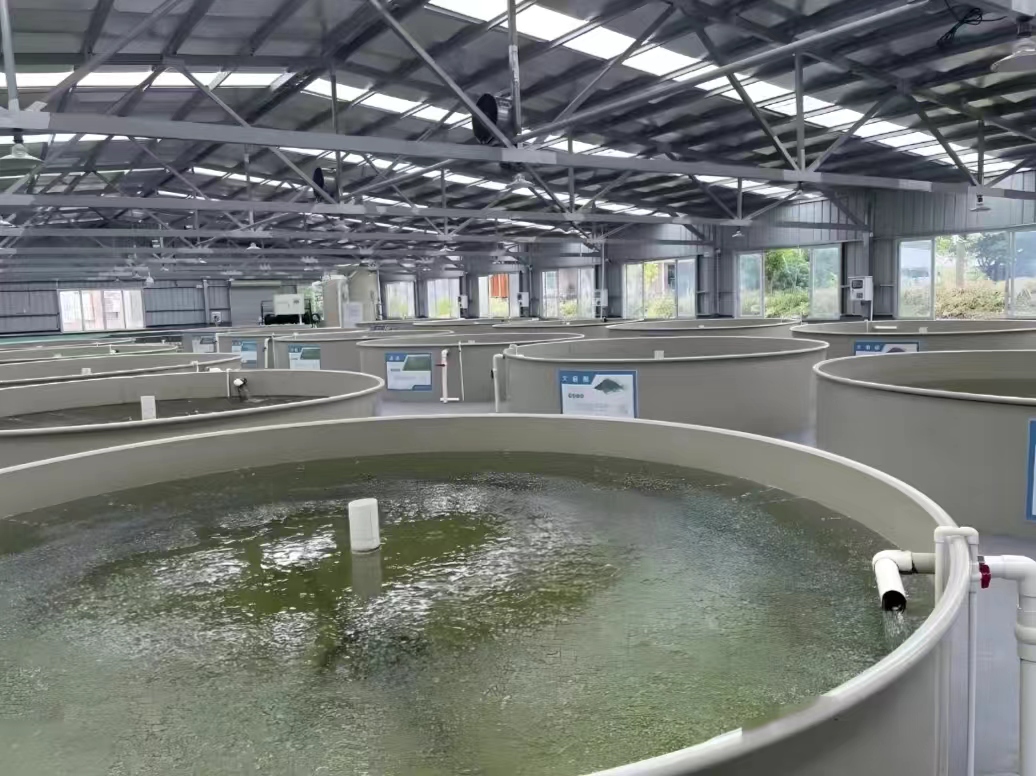
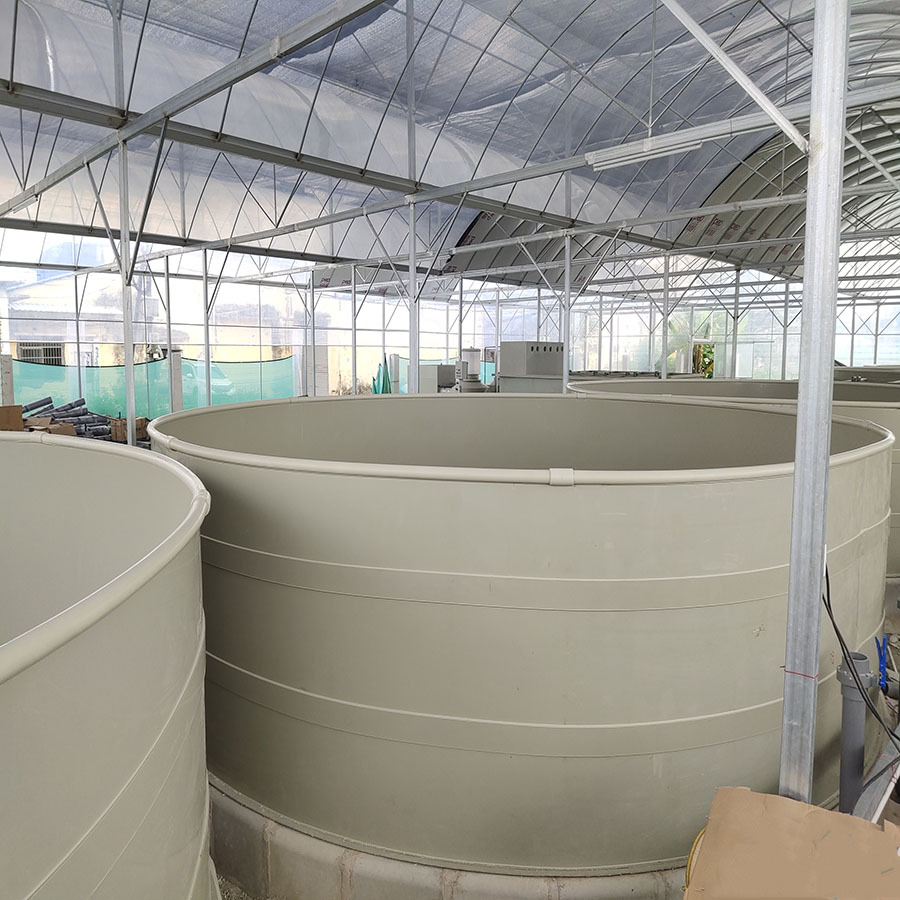
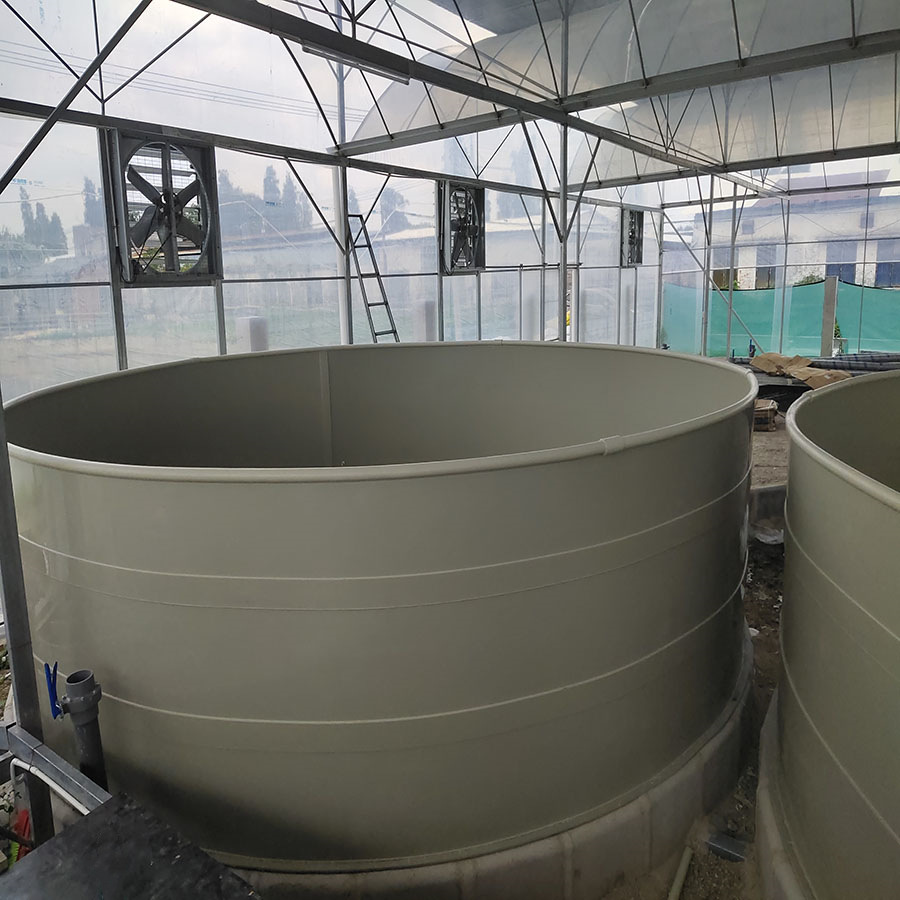
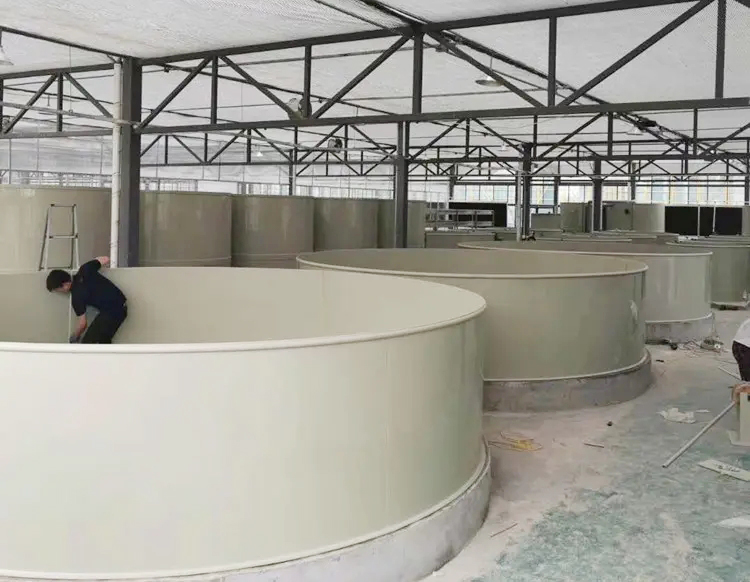
Right for: medium to large RAS, seawater or freshwater, indoor greenhouse or factory-style production.
Wrong for: anyone who wants a fit-and-forget 20-year-plus installation, or who has budget for the strongest structure available. If your aquaculture tank material comparison is really about the next 10-15 years rather than 30, this is usually where it lands.
FRP Tanks: Longest Life, Highest Strength, Biggest Ticket
FRP (fibreglass reinforced plastic) is a composite of glass fibre and resin. It delivers the highest strength, longest life and widest temperature and chemical tolerance — and it is also the most expensive of the three. In a long-horizon aquaculture tank material comparison, FRP tops the table on every performance line except price.
An FRP fish tank reaches RAS in one of two forms: one-piece moulded units, typically 2–5 m in diameter for small and mid-size applications, and modular tanks built from SMC moulded panels on site, which reach 8–12 m and suit large industrial installations.
The hard numbers behind FRP
- Longest service life: 15–30 years in normal service, ahead of both PP and galvanized canvas. Once you divide cost across the water volume and the years, it is frequently the cheapest per year.
- Widest temperature window: -40 °C to +110 °C covers boiling-water disinfection, steam sterilisation and cold overwintering. For high-value species and dense recirculating systems that headroom is decisive.
- Highest structural strength: at equal diameter and height, FRP resists impact and deformation far better than PP or canvas. Above 8 m or at high water level, it is essentially the only option that will not bulge.
- Best chemical resistance: acids, alkalis, salt and oils — stable through disinfection cycles, marine culture and specialist species such as crocodile and soft-shell turtle.
Two hard constraints on FRP
- Higher unit price: for the same volume, expect roughly 1.5–2× a PP tank and 3–4× a galvanized canvas tank. But once you convert to cost per m³ per year, the ranking can flip.
- Delivery and installation need a crew: large modular FRP tanks require a trained team for assembly, sealing and jointing. Allow 1–3 days on site — more than canvas or PP will ever need.
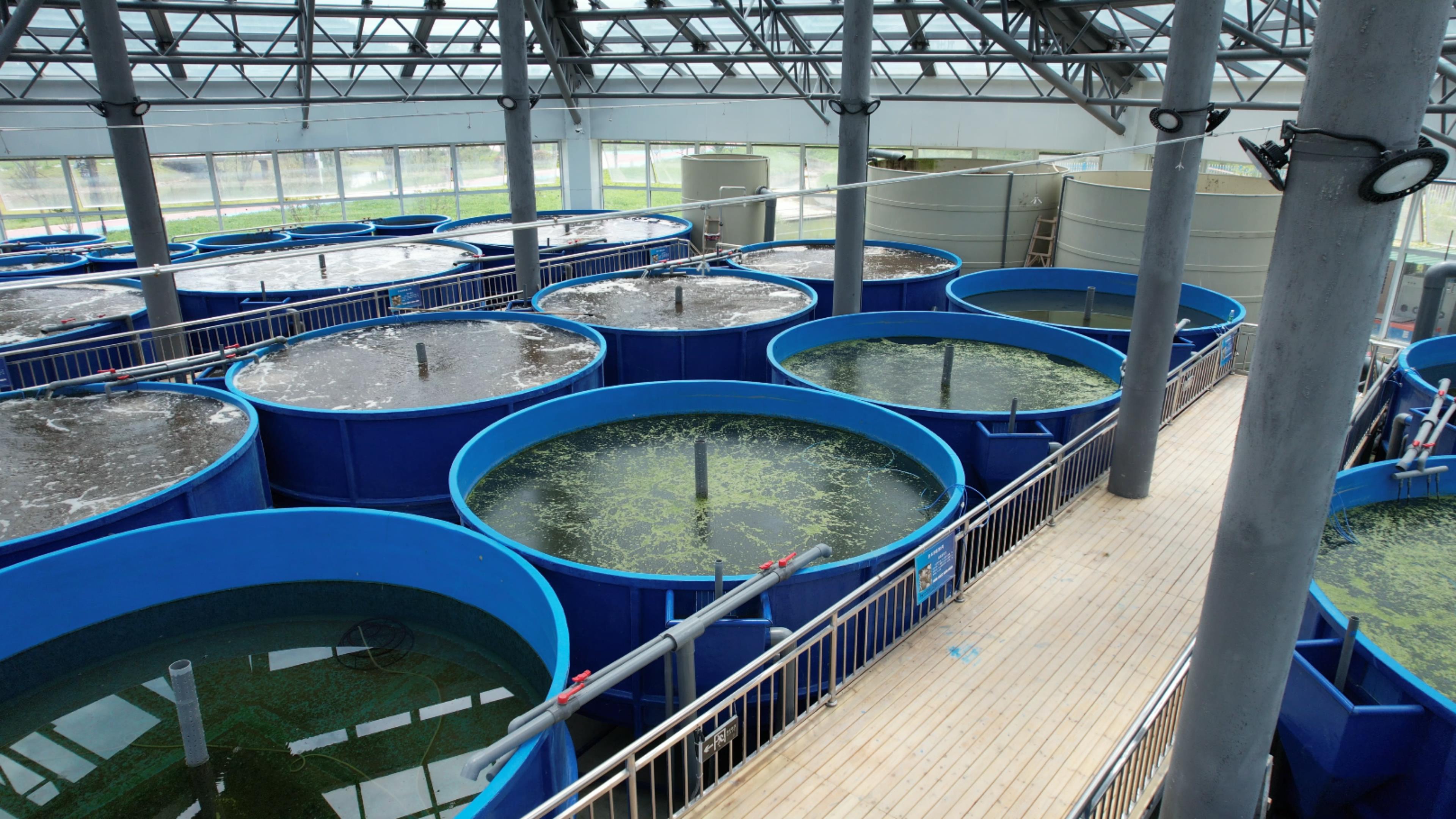
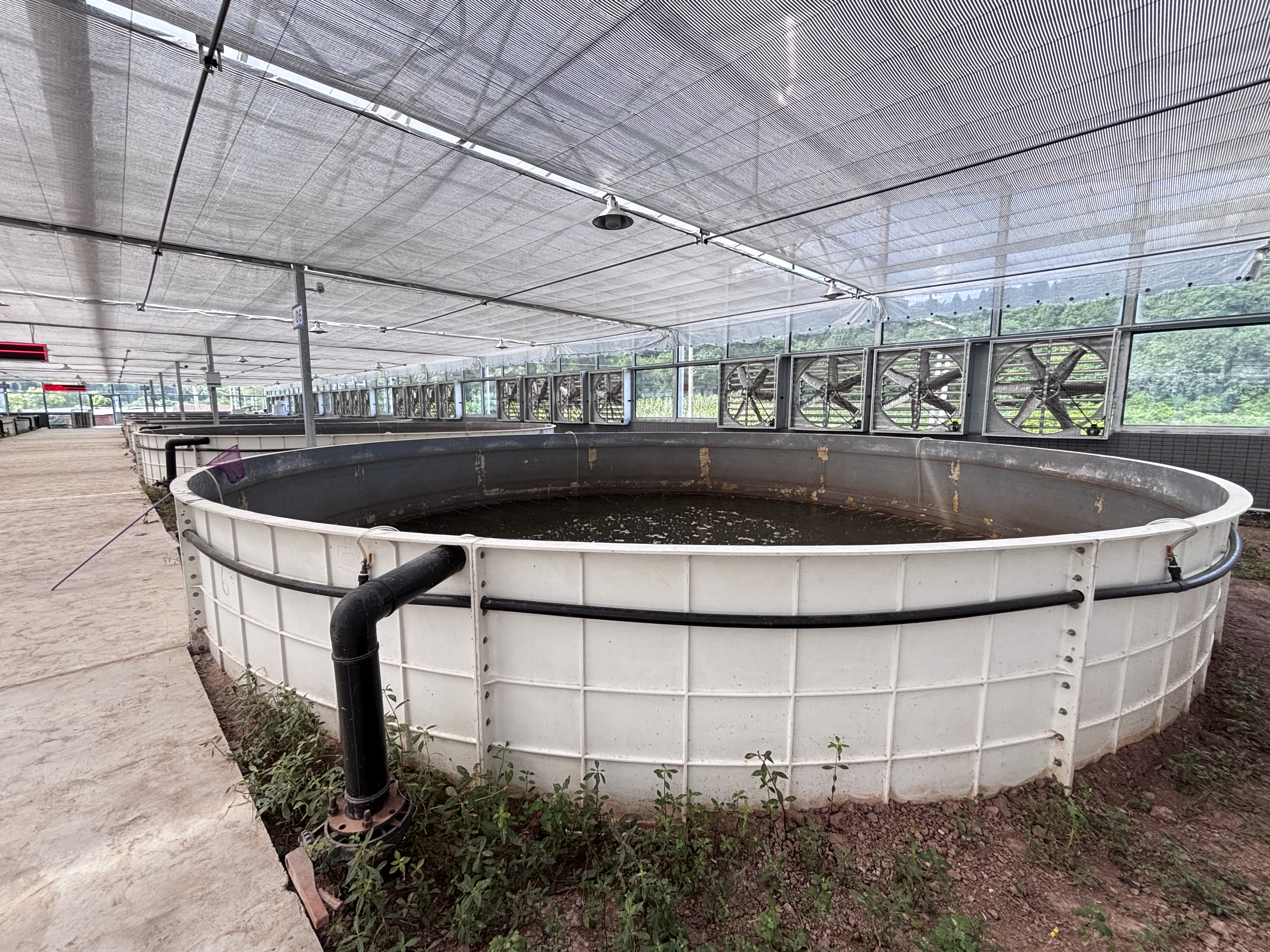
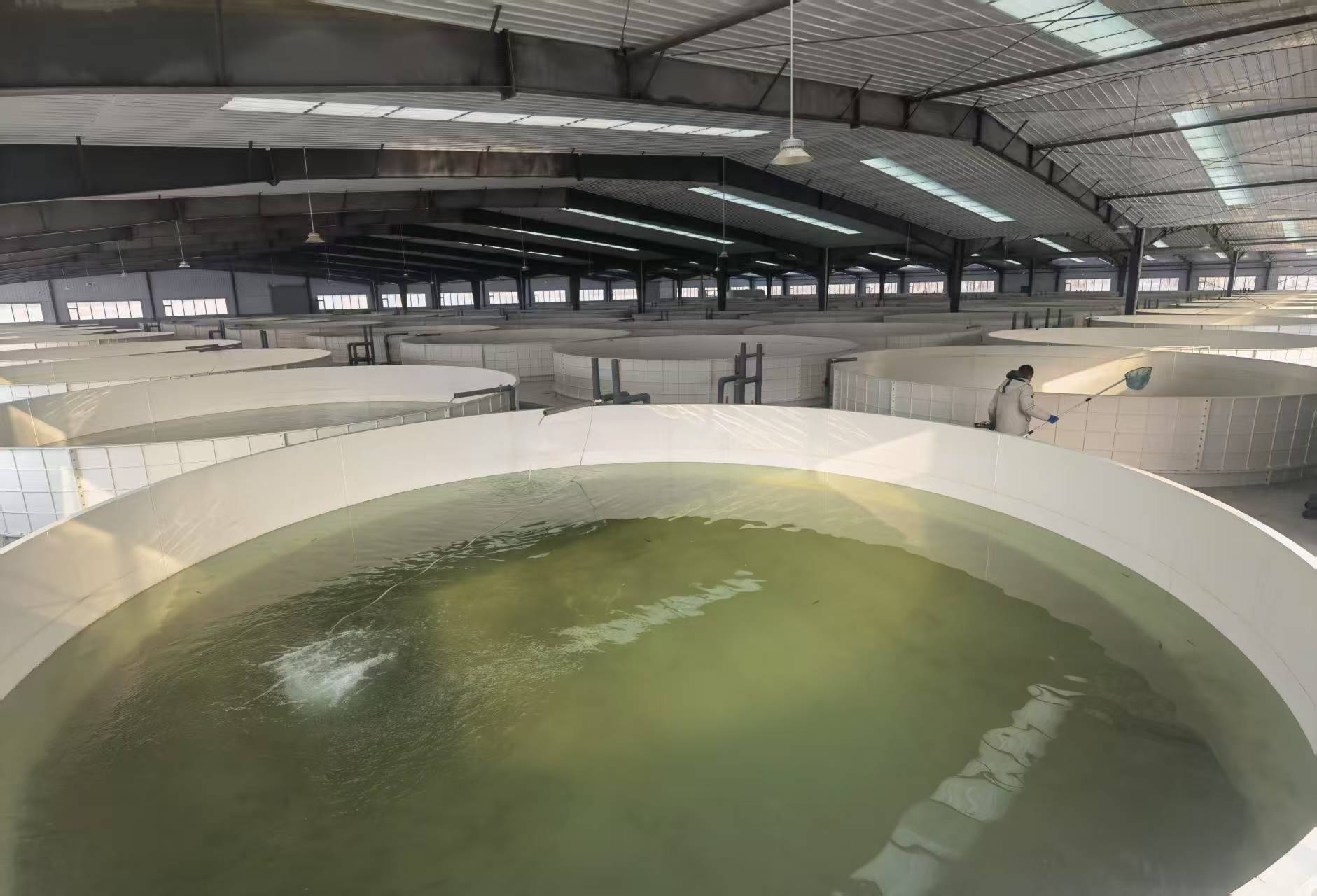
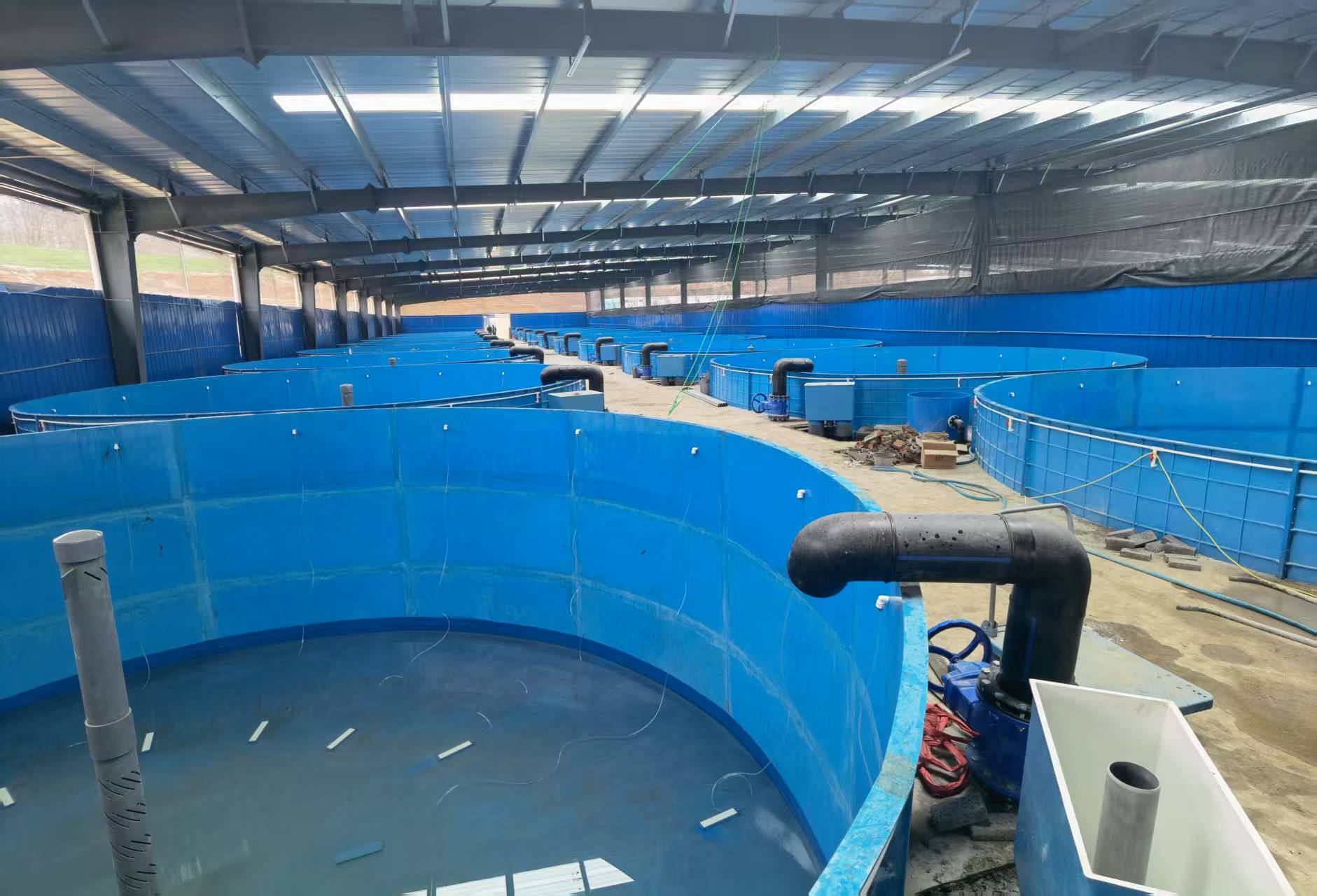
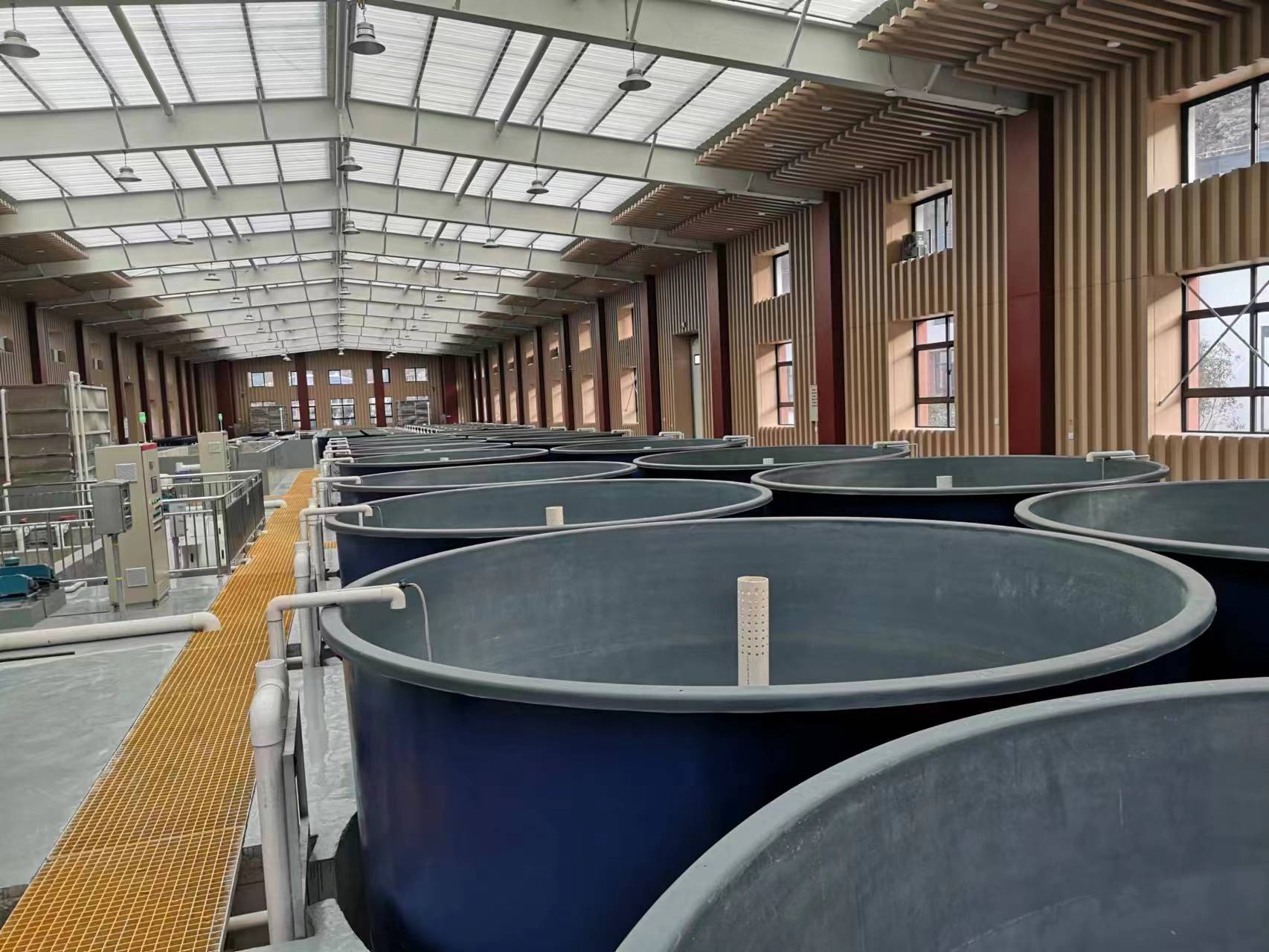
Right for: industrial RAS, marine culture, specialist species, long-horizon investors, government and research demonstration projects.
Wrong for: short trials, very tight cash flow, or operations that need to move tanks frequently. An aquaculture tank material comparison only favours FRP once you are committed to the site for the long run.
How to Choose: A 3-Step Checklist
With the three materials covered, here is the same thinking as a working checklist. Keep a notepad handy and match your situation to each step - an aquaculture tank material comparison is only useful once it turns into a decision.
Step 1 — Start with your water
- Freshwater, ambient temperature: all three work. Choose on budget and service life.
- Seawater or brackish: rule out galvanized canvas — the liner will not survive long-term salt exposure. Go PP or FRP.
- Hot-water or steam disinfection: FRP, full stop. The other two will not take it.
Step 2 — Look at your site
- Open yard, strong sun, no shade: skip galvanized canvas. PP under a roof, or FRP.
- Greenhouse or factory building: PP and FRP both fit; treat canvas as a transition tank only.
- Large diameter (> 6 m) or high water level (> 1.5 m): go straight to FRP. That is structural, not a matter of taste.
Step 3 — Run the numbers
Most buyers compare unit price. The better measure in any aquaculture tank material comparison is cost per cubic metre per year:
Annual cost per m³ ≈ (tank price + installation + maintenance) ÷ (tank volume × expected service life)
Worked example, all at 6 m diameter × 1.2 m high:
- Galvanized canvas: about $1,100 per tank, liner replaced every 3 years → roughly $6.90 per m³ per year.
- PP: about $2,100 per tank, 12-year service life → roughly $5.00 per m³ per year.
- FRP: about $3,900 per tank, 25-year service life → roughly $2.20 per m³ per year.
See the pattern? On a long-horizon calculation, FRP comes out cheapest. Once service life is in the equation, an aquaculture tank material comparison often reverses the answer you get from sticker price alone. It is why plenty of experienced operators run canvas for a first pilot, then switch to FRP the moment they scale up.
PP Tank RAS Farm — Site Video
The clip below was filmed at a farm we supplied. It runs from filling through recirculation equipment in operation to a routine tank walk, so you can see what PP tanks actually look like inside a working industrial RAS. Numbers in an aquaculture tank material comparison only go so far; this is what PP looks like in daily service.
FAQ: Aquaculture Tank Material Comparison
Need this aquaculture tank material comparison applied to your own site?
Share your water quality, species, scale and budget and we will put together a free one-to-one aquaculture tank material comparison and quotation — shipped factory-direct, with custom diameter, height, colour and reinforcement.