

Introduction: Why FRP Storage Tank Selection Is Not One-Size-Fits-All
In chemical, environmental, food, and pharmaceutical industries, the FRP storage tank is the core containment vessel. The right choice directly affects safety, operating cost, and service life.
FRP — fiberglass-reinforced plastic — has steadily replaced carbon steel and stainless steel because it is lightweight, strong, corrosion-resistant, and highly designable.
Even so, an FRP storage tank is not a single product. The three most common types — integral filament-wound, site-assembled, and site filament-wound — each fit a different working condition. This article breaks down the trade-offs.
1. Integral Filament-Wound: The Reliable Choice for Mid-Sized Tanks
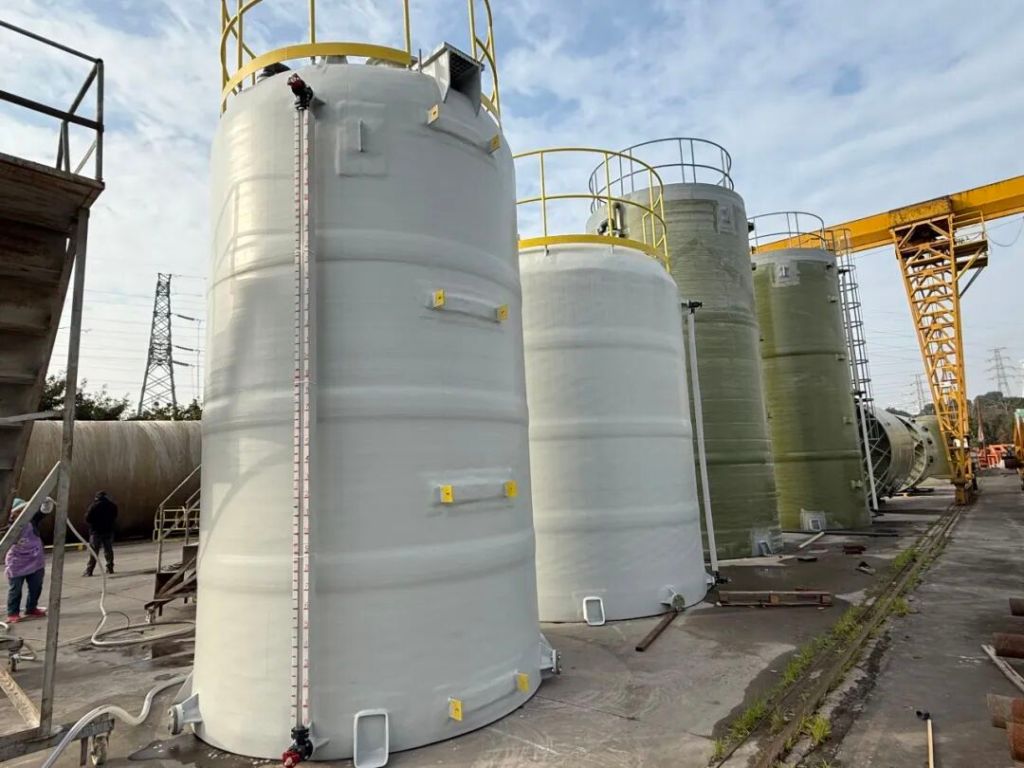
An integral filament-wound FRP storage tank is produced by a microcomputer-controlled filament winding machine, with the entire body wound at the factory.
Core Strengths
- One-piece factory production: winding angle and resin content are precisely controlled.
- A seamless, fully wound body gives top-tier sealing and pressure resistance.
- Long-term resistance to acids, alkalis, and organic solvents.
- Stable quality, high factory pass rate, short lead time, and competitive batch pricing.
- Low maintenance, with a service life of 30+ years in normal service.
Limitations
The finished shell cannot be broken down for shipping. Oversize bodies hit road, bridge, and tunnel limits, so capacity and dimensions are constrained by transport.
Best-Fit Scenarios
- Mid-sized acid and alkali storage in chemical plants; raw material storage in pharma.
- Clean-service storage (drinking water, juice) using food-grade resin with NSF certification.
- Sites with clear transport routes and no height/width limits.
- Mid-sized projects where sealing matters and budget is controlled.


2. Site-Assembled: The Space-Breaker for Oversize Capacity
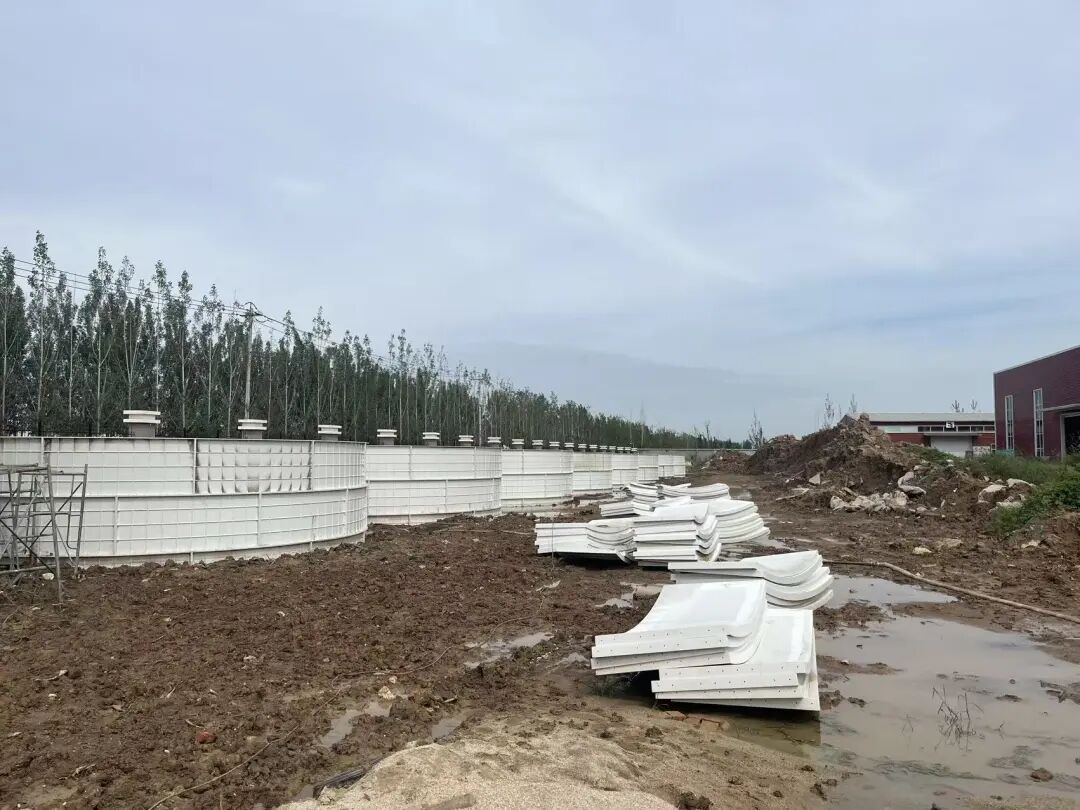
The site-assembled FRP storage tank follows a “divide and conquer” logic: panels are prefabricated in the factory, then joined on site.
Core Strengths
- Completely sidesteps transport size limits, enabling oversize capacity and dimensions.
- Panels can be sized to fit unusual site footprints.
- Strong adaptability to complex or constrained sites.
Limitations
- Joints mean sealing is weaker than integral winding; assembly and sealant quality are critical.
- Needs a specialized crew: lifting, joining, curing. Long on-site time, high install cost.
- Temperature and humidity at the site directly affect the result and must be controlled.
Best-Fit Scenarios
- Large chemical parks and wastewater plants needing oversize storage (typically 1,000 m³ and up).
- Remote sites with narrow roads, low bridges, or height-restricted tunnels.
- Atmospheric storage of mildly corrosive media where top-tier sealing is not required.
- Large engineering projects that can absorb a longer construction window.

3. Site Filament-Wound: The All-Round Choice for Demanding Projects
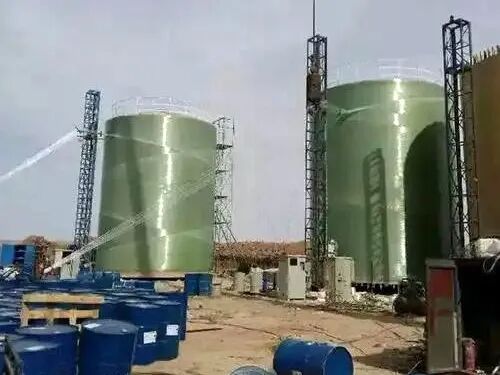
The site filament-wound FRP storage tank is the upgrade that takes the best of both: a mobile winding machine builds the entire shell on site.
Core Strengths
- Keeps the seamless advantage of integral winding, with matching sealing and pressure rating.
- Handles high temperature, high pressure, and strongly corrosive media.
- No transport limit on capacity, and no assembly joints to leak.
- Process parameters can be tuned in real time to match the exact medium and duty.
Limitations
- High entry barrier: needs mobile winding equipment and an experienced crew.
- Strict demands on site flatness, space, and curing temperature/humidity.
- Longer schedule than site-assembled tanks. Equipment logistics and commissioning add cost; total cost is the highest of the three.
Best-Fit Scenarios
- Large petrochemical and new-energy projects where sealing and pressure rating are critical.
- Oversize storage of strongly corrosive media (e.g.g., large hydrochloric or sulfuric acid tanks).
- Remote industrial projects that are transport-limited but cannot compromise on tank quality.
- Core industrial scenarios where budget supports long-term stable operation.
4. FRP Storage Tank Types: Side-by-Side
| Dimension | Integral Filament-Wound | Site-Assembled | Site Filament-Wound |
|---|---|---|---|
| Build process | Factory filament winding | Prefab + on-site joining | Mobile winding on site |
| Body integrity | Seamless | With joints | Seamless |
| Sealing & pressure | Top-tier | Medium | Top-tier |
| Capacity ceiling | Limited by transport (mid-size) | No limit (1,000 m³ and up) | No limit |
| Transport difficulty | High (finished shell) | Low (panels) | Low (equipment) |
| On-site time | Very short | Long | Longest |
| Total cost | Low–medium (best in batch) | Medium | Highest |
| Typical duty | Mid-size chemical, pharma, food | Large chemical, atmospheric wastewater | Large petrochem, strong-corrosion media |
5. FRP Storage Tank Selection: Four Dimensions to Weigh
An FRP storage tank is chosen by matching process to duty. Weigh four dimensions together:
- Capacity & transport: mid-size and clear routes → integral winding; oversize or transport-limited → site-assembled or site filament-wound.
- Medium & pressure: mild corrosion and atmospheric → site-assembled acceptable; high temperature, pressure, or strong corrosion → integral or site filament-wound.
- Site & schedule: tight window → integral winding; flexible schedule → site-assembled or site filament-wound.
- Budget: limited → integral winding; flexible → all three are viable on a case-by-case basis.
Quick rules of thumb:
- Mid-size capacity, clear transport, high sealing demand → pick integral filament-wound (standardized, best value).
- Oversize capacity or transport-limited, mild-corrosion atmospheric duty → pick site-assembled (flexible fit).
- Transport-limited, high sealing and pressure demand → pick site filament-wound (oversize without compromising quality).
Always follow three principles: qualifications first, precise matching (avoid over- or under-spec), and reliable after-sales support.
6. FAQ: FRP Storage Tank Selection
Q1. Why are FRP storage tanks gradually replacing carbon steel and stainless steel?
FRP is lightweight, corrosion-resistant, and highly designable. In acid, alkali, and solvent service, an FRP storage tank typically delivers longer life and lower total cost than carbon or stainless steel.
Q2. Both are built on site — what’s the difference between site-assembled and site filament-wound?
Site-assembled tanks are joined from prefabricated panels, so they have joints and medium sealing. Site filament-wound tanks are wound as a whole on site, so the shell is seamless with sealing matching factory-wound tanks — but at a higher cost and longer schedule.
Q3. How long does an integral filament-wound FRP storage tank last?
With correct installation and routine maintenance in normal service, an integral filament-wound FRP storage tank lasts 30+ years.
Q4. When is a site filament-wound tank the only real choice?
When the duty combines oversize capacity, strong-corrosion media (such as large hydrochloric or sulfuric acid tanks), transport limits, and uncompromising sealing and pressure requirements — typical of large petrochemical or new-energy projects.
References & Further Reading
Need Help Selecting an FRP Storage Tank?
Whether you are sizing a new tank or rebuilding an existing one, our team can support you with material selection, type matching, and a compliant installation plan for any FRP storage tank project.